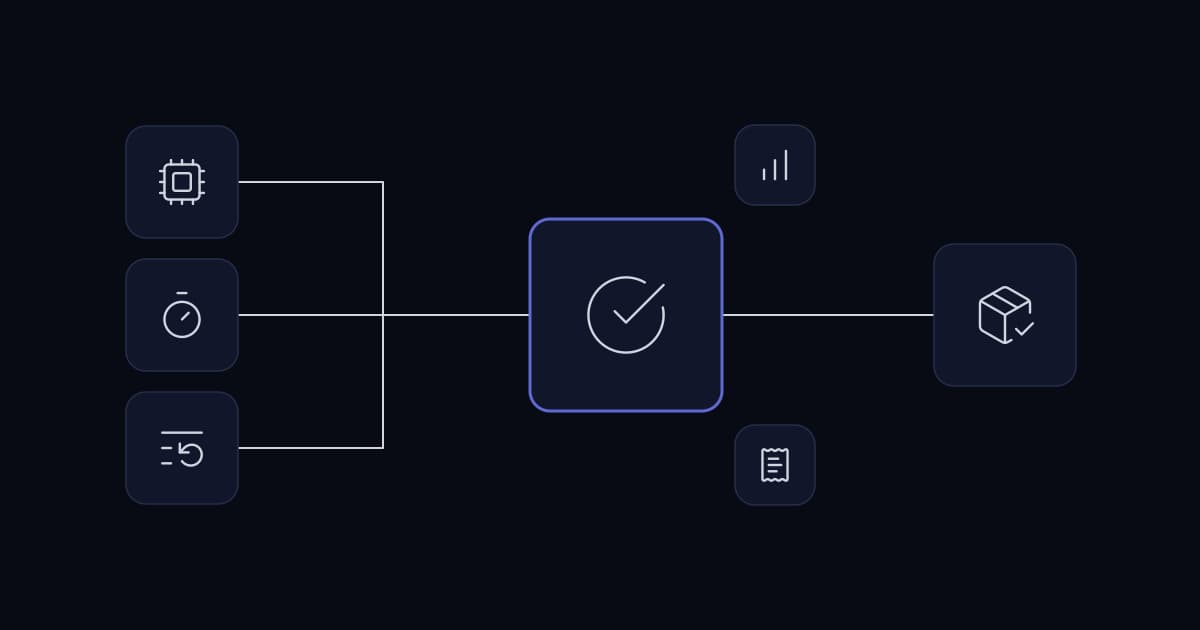
An AI pilot can look inexpensive because the invoice arrives from the model provider while the correction work stays in somebody else's calendar. The application produces drafts cheaply, reviewers repair them and the budget report counts only the drafts.
AI cost per completed task includes the resources spent on accepted outcomes and on the attempts that fail to produce them. It is a more useful purchasing measure than the price of an individual model call.
Define the completed task first. Then include model consumption, external services, infrastructure, review and operating support. Compare that cost with the current process at an equivalent quality level.
Choose a unit the business recognizes
Provider pricing reference
- OpenAI API pricing— Check current metered rates and applicable processing options; the task-cost framework below also includes your own operating effort.
A completed task might be an accepted case summary, a validated document record or a customer response actually approved for sending. “One request” is usually a technical unit, not a business outcome.
The denominator should exclude outputs that were generated but never accepted. At the same time, the numerator must retain the cost of producing those rejected outputs. Otherwise the report rewards the system for creating work nobody can use.
Define whether a task requiring manual completion still counts as AI-assisted completion. It can count, but the associated manual cost must be included and the reporting should distinguish it from a clean automated result.
Avoid moving the finish line
If a pilot initially measures reviewed summaries and later counts unreviewed drafts, apparent productivity may improve without any real improvement. Keep the completion definition stable or report the change explicitly.
The person who owns the business process should approve that definition. Engineering can measure it, but should not unilaterally decide what the organization considers finished.
Build the cost ledger around the job
Assign a job identifier that follows the workflow through source retrieval, model calls, tool operations, validation and review. Aggregate usage against that identifier.
Record the model and configuration used, not merely the provider. Include retried calls and fallback routes. Where billing data arrives later, reconcile estimates against actual charges.
Separate costs that scale with use from costs that exist even when the feature is quiet. A small workload may have low model consumption and relatively high fixed support cost. That does not make it unsuitable, but it changes the business case.
| Cost category | Examples | Allocation question |
|---|---|---|
| Model usage | Input, output and applicable processing charges | Which job and route generated the usage? |
| Supporting services | Retrieval, transcription and external tools | Is the charge per request, duration or stored item? |
| Infrastructure | Workers, databases and retained artifacts | What portion exists for this workflow? |
| Human work | Preparation, review, correction and exceptions | Is time measured consistently? |
| Operations | Support, upgrades and evaluation maintenance | Which costs recur after the pilot? |
Use provider documentation and the applicable commercial agreement for current billing units. Do not infer a price from a generic example or a consumer subscription.
A transparent worked example
Consider a hypothetical month with 1,000 attempted case summaries. The team accepts 800. Model and supporting service costs total 120 currency units, allocated infrastructure costs 180, and 20 hours of review cost 500 at an assumed internal rate of 25 units per hour.
The resulting operating cost is 800 units, or one unit per accepted summary. The numbers are illustrative assumptions, not a vendor quote or a KYCONNECTS customer result.
If someone reports only the 120 units of API-related costs divided by 1,000 attempts, the result is 0.12 units per attempt. That figure is mathematically valid but answers a different question. It says little about the cost of usable work.
Add manual exceptions honestly
Suppose the 200 rejected cases require another ten hours of manual completion. Include that cost when comparing the end-to-end process with the manual baseline.
Report both the accepted AI-assisted unit and the cost of handling the whole incoming workload. This prevents an apparently efficient feature from shifting its expensive cases into an unmeasured queue.
Measure preparation and review separately
Input preparation can include collecting records, removing sensitive fields and correcting inconsistent documents. Review can include evidence checking, rewriting and resolving disagreements.
These activities respond to different improvements. Better connectors can reduce preparation. A clearer output contract can reduce review. A different model may affect either, but the measurement should identify where time actually changes.
Use a practical time-recording method that does not create more work than it measures. Sample representative tasks or record workflow events with a clear definition of active time. Avoid interpreting an open browser tab as continuous labour.
Separate capacity from cash savings
If a salaried team spends fewer hours on summaries, the organization has released capacity. It may use that capacity to handle more cases, improve service or reduce overtime. Those are valuable outcomes.
They are not automatically a reduction in payroll expense. A financial saving requires a change in actual spending or a defensible avoided cost.
Report the operational benefit in its own terms: fewer review hours, shorter queue age or more completed work at the same staffing level. Finance can then decide how to value it without an inflated return-on-investment claim.
Include the cost of being wrong
Some errors are cheap to correct before publication. Others lead to customer rework, missed commitments or incident investigation. A budget that ignores failure consequences can favour an inappropriate model or workflow.
Do not invent a universal monetary value for an AI error. Use the business's actual incident and correction records where available. Where evidence is limited, describe the risk and test the decision under several explicit assumptions.
A workflow that cannot tolerate an unsupported financial commitment may need stricter validation and more review than an internal topic classifier. Its higher operating cost can be justified by the consequence it avoids.
Keep quality constant when comparing costs
If a cheaper route accepts more inaccurate outputs, it has changed the service rather than reduced the cost of the same service. Compare configurations against the same acceptance criteria.
Where the business deliberately accepts a different quality level, record that as a policy decision. Do not hide it inside a cost optimization.
Understand the shape of the workload
Average usage can be misleading when a small number of long or difficult jobs dominate spending. Track the distribution by task class and input size, while keeping sensitive content out of the cost ledger.
Separate interactive work from scheduled work. A background report may tolerate a queue that a live customer interaction cannot. That difference affects the available processing and infrastructure choices.
Also examine seasonality and bursts. A quiet pilot can underestimate review staffing and capacity needs during a month-end reporting peak.
Set limits that preserve useful work
Use per-job and per-period budgets. A job limit prevents a loop from consuming resources indefinitely. A portfolio limit helps the business manage total exposure.
Define the response to a limit. The system might pause a background job, reduce optional enrichment or return the task to a manual queue. It should not silently produce an incomplete result labelled complete.
Record why the limit was reached. A frequent budget stop may indicate an unrealistic task scope, repeated tool failures or a route that is unsuitable for the workload.
Evaluate cost changes with a controlled comparison
When changing a prompt, model or retrieval method, compare the same representative tasks. Measure accepted outcomes, review effort and complete job cost.
Do not optimize only the easiest cases. Include malformed inputs, conflicting evidence and the exceptions that consume the team's time.
Keep the previous configuration available long enough to investigate a regression. If usage drops because the system now omits required analysis, the lower invoice is not an improvement.
Reference
- AI evaluation— Establish acceptance criteria before comparing operating costs.
Budget for the work after launch
An enterprise integration needs credential rotation, source-adapter maintenance, incident response and periodic evaluation. Someone must review changes in model behaviour and provider interfaces.
Assign those responsibilities and include them in the recurring budget. A prototype maintained informally by one enthusiastic employee can look artificially cheap.
Separate the one-time build cost from recurring operation, but do not make either disappear. A project with a modest monthly cost may still need a sensible payback period for its engineering investment.
Include retirement costs
The business may stop using the feature. Plan how to disable jobs, export necessary records, delete retained data and remove credentials.
A small amount of exit planning prevents an abandoned pilot from leaving paid services and sensitive data behind. It also makes the initial purchasing decision easier to reverse.
A useful monthly review
Review cost per accepted task alongside volume, acceptance rate, correction categories and queue age. A cost increase may be reasonable if the workload became more difficult or the feature took over more valuable work.
Ask which change would produce the greatest improvement. It might be better source data, a narrower task, a faster review process or removal of an unnecessary model step.
KYCONNECTS can help instrument the workflow so that these questions can be answered from operational records. The purpose is to make spending explainable, not to add another dashboard without an owner.
Compare two designs using the same completed task
Suppose one design uses a stronger model for every request. Another starts with a smaller model and escalates difficult work. Comparing only their first API calls favors the second design, but it misses escalation, additional retrieval, reviewer time and work abandoned after an incorrect draft.
Run both designs against the same task set and the same acceptance criteria. Record every attempt under a shared task identifier. Keep failed tasks in the results. Otherwise, a system can appear inexpensive simply because it completes only the easy work and leaves the rest to employees.
For each task, record the metered charges your application can observe and the operational work required to finish it. Separate measured costs from estimates. If reviewer time is sampled rather than tracked continuously, explain the sampling method and avoid reporting a misleadingly precise total.
A useful comparison can show that the more expensive model is cheaper for a particular workflow because it reduces rework. It can also show that no model is needed for a deterministic step. The purpose of the exercise is to identify a workable process, not to justify a preferred provider.
Treat latency as a business constraint
A cheap response that arrives after the employee has completed the task manually has little practical value. Include an acceptable turnaround time in the completion criteria. Measure queue time, tool time and review time separately so the team knows where to intervene.
Not every delay needs a faster model. Slow document access, repeated authentication or an unavailable approver may dominate the elapsed time. Improving those dependencies can change the economics more than switching model tiers.
For unattended work, longer turnaround may be acceptable if the application communicates status and meets the business deadline. Batch processing and interactive assistance therefore need different cost comparisons. Do not combine them into a single average that hides the service expectation.
Turn the pilot ledger into a budget conversation
After the pilot, group tasks by business outcome and difficulty. Explain which workload assumptions drive the forecast: requests per period, average attempts, escalation frequency, document volume and review effort. Use a range when those inputs are uncertain.
Keep the forecast connected to an operational limit. The person paying for the service should know what happens when a department reaches its budget, whether pending tasks remain recoverable and who can approve additional use. An alert that arrives after unrestricted work has already run is useful accounting, but weak cost control.
For an initial assessment, supply a representative task sample, the current completion process and available usage records. Avoid sharing customer data that the estimate does not require. These inputs let an integration team discuss likely cost drivers without promising an unsupported monthly saving.
Review the model again after the workflow changes. Better source data, shorter approval queues and fewer unnecessary steps can alter cost per accepted task even when provider prices remain unchanged. That is why the operating metric belongs to the business process, not just the API invoice.
Budgeting questions
Is token price enough to compare AI providers?
Token price is one input. A meaningful comparison includes actual consumption, supporting services, retries, review, infrastructure and the number of accepted outcomes.
Should rejected outputs be included in the cost calculation?
The cost of rejected attempts belongs in the numerator. If the metric is cost per accepted task, rejected outputs do not belong in the denominator.
Does time saved always mean money saved?
Reduced staff time usually creates capacity first. Cash savings depend on an actual reduction in spending, avoided expenditure or another financial effect that the business can substantiate.
Put the number beside the outcome
A credible budget can explain what one completed task means, what it costs and what level of quality the business receives. That is enough to make a practical decision without a speculative transformation forecast.
Reference
- AI integration services— Scope and measure the complete business workflow.
- GPT model routing— Use measured economics when assigning models to tasks.
Discuss your requirements
- Assess the cost of an AI workflow— Describe the current task, completion criteria, volume and review effort.
Services This Relates To
Written by KYCONNECTS Engineering. Client names are withheld under confidentiality.