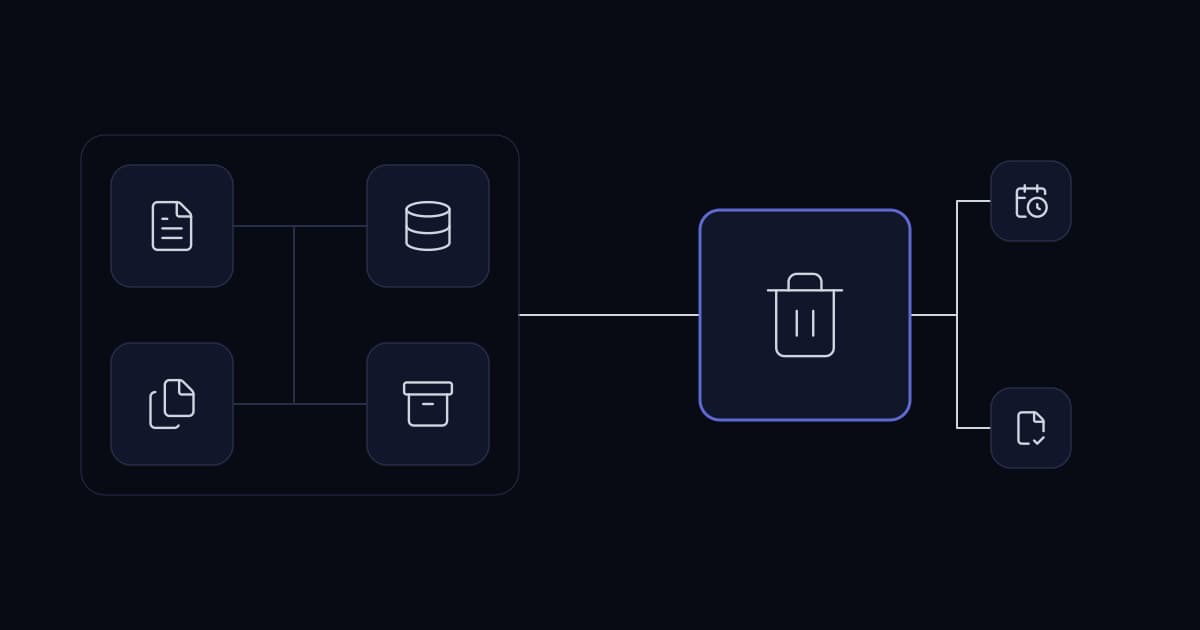
A business approves an AI service because its data is not used for model training. The application then stores uploaded files, keeps full prompts in a debugging platform and saves generated summaries in several systems. The training statement may be accurate while the organization's data inventory remains incomplete.
Enterprise AI data retention is the lifecycle of every relevant copy created by the workflow. It includes source extracts, model requests, hosted state, search indexes, logs and final artifacts.
Map those copies before using sensitive records. Assign an owner, purpose, access boundary and deletion rule to each. Then verify the actual provider route and application configuration rather than relying on a general product description.
Separate questions that procurement often combines
Training use asks whether submitted data is used to improve a model. Retention asks what remains stored and for how long. Residency asks where relevant processing or storage occurs. Access asks who can retrieve it.
These are related but separate decisions. A service can exclude training use while retaining operational data. A regional endpoint may still involve other services whose behaviour needs review.
Describe the requirements in plain language. “Customer documents must not be retained beyond the approved processing purpose” is more actionable than a broad request for an “enterprise-grade AI platform.”
Confirm which service you are buying
A consumer chat application, a direct model API and a cloud marketplace route can have different terms and controls. Record the actual product, account arrangement, endpoint and enabled features.
Do not reuse the data review for one route as automatic approval for another. A change in hosting or a newly enabled tool can change the data path.
Draw the complete workflow
Follow a representative record from the source system to the final business artifact. Include intermediate workers, retrieval services, model providers and observability tools.
For a call-summary feature, the copies may include audio, transcript segments, the model request, the draft summary, the approved CRM note and diagnostic events. Each has a different purpose.
For a knowledge assistant, include extracted text, chunks, embeddings, cached answers and citation metadata. Deleting the original upload may not remove all derived material.
| Copy or service | Question to answer | Typical owner |
|---|---|---|
| Source extract | Why is this field needed for the task? | Business application owner |
| Model request | Which endpoint and controls apply? | AI integration owner |
| Hosted files or state | What persists after the request? | Platform administrator |
| Retrieval index | How are updates and deletions propagated? | Search owner |
| Diagnostic data | Is content captured and who can inspect it? | Operations and security |
| Final artifact | Which record policy governs the result? | Business process owner |
Read provider controls at the feature level
OpenAI's data-control documentation distinguishes abuse-monitoring retention, application state and endpoint-specific behaviour. It also notes that data sent to third-party MCP servers follows those services' retention policies.
The practical lesson is to review the features actually used. A short text request, a hosted file and a persistent conversation can create different retention obligations.
Reference
- OpenAI: Data controls in the platform— Review current endpoint and feature behaviour for the intended configuration.
This article does not prescribe one provider's settings for every deployment. Eligibility, account arrangements and feature limitations must be checked against the current documentation and applicable agreement.
Minimize before sending
Remove fields the task does not need. An internal summary may need a case reference and problem description without a full contact profile. A trend analysis may work with aggregated data rather than identifiable records.
Minimization is more dependable than expecting a later deletion process to compensate for unnecessary collection. It can also simplify review and reduce the number of systems that need access.
Be careful with free-text fields. They can contain sensitive information that the structured schema does not reveal. Review representative inputs and define how unusual content is handled.
Pseudonymization is not the same as anonymity
Replacing a name with an identifier can reduce direct exposure, but linked records or contextual detail may still identify a person or organization.
Keep the mapping controlled and describe the data accurately in the review. Do not label a dataset anonymous simply because one obvious identifier was removed.
Make retention follow purpose
A transient request, an operational trace and an approved business record may need different retention periods. Choose them according to the legitimate purpose and applicable requirements.
Avoid one global “keep everything” setting. It may be convenient during development but difficult to justify and expensive to unwind later.
Document who can authorize an exception, such as preserving records for an investigation. The exception should have a scope and an end condition rather than becoming permanent by default.
Design deletion across derived data
Give source records stable identifiers that can be traced into derived copies. When a record must be removed, the application needs to know which chunks, cached answers and stored artifacts are affected.
Some outputs combine multiple sources. Decide whether deletion requires regenerating the output, removing it or retaining it under a separate justified policy.
Backups add another lifecycle. Explain how deleted data ages out of backup copies and how restoration avoids reintroducing records that should remain deleted. Do not promise immediate erasure from every medium unless the architecture actually supports it.
Verify deletion instead of recording only the request
A deletion task can fail like any other integration. Record completion per system and surface exceptions.
Test retrieval after deletion and check caches. A successful API response from one store does not establish that every derived answer is gone.
Keep access aligned across copies
A confidential source should not become widely accessible because its generated summary is short. Apply an appropriate access boundary to the output and any diagnostic record containing its content.
For multi-tenant systems, preserve tenant identity through processing and storage. A shared model integration should not lead to shared artifact access.
Review operational roles. A support engineer may need status and error metadata without needing the full customer document. Provide separate access paths for sensitive investigations.
Treat observability as part of the data design
During development, full prompts and responses make debugging easy. In production, they can create a large secondary repository of sensitive material.
Start with metadata such as job IDs, model configuration, timing and failure categories. Capture content only through an approved diagnostic process where it is needed.
Define retention and access for that content before enabling it. A short-lived investigation should not silently change the default collection for every future request.
Reference
- AI application observability— Diagnose workflow failures without routinely retaining all source content.
Review third-party tools separately
An AI workflow may call an external search service, MCP server, document converter or transcription provider. The model provider's policy does not automatically cover those services.
List each processor and the information sent to it. Confirm the relevant agreement, controls and deletion mechanism.
Do not let a model choose a new external destination as a convenience during a task. The application should enforce the approved processing path.
Include human access
A provider's support process or an internal review team may involve human access under defined conditions. Ask how that access is controlled and audited.
The business needs an accurate account of the workflow, not a blanket statement that no person can ever see the data when the actual support arrangement is more nuanced.
A hypothetical document-review deployment
A company wants AI to prepare internal summaries of supplier documents. The first design sends entire files and retains every request for debugging.
The review identifies that only a defined set of sections is needed. The application extracts those sections, records source references and avoids unnecessary contact details.
Drafts stay in a restricted review area. Approved summaries move into the procurement record under its retention policy. Diagnostic logs contain job metadata, while content capture requires a separate investigation setting.
A deletion exercise follows one withdrawn document through extraction storage, the retrieval index, draft storage and caches. The team records a failure in cache invalidation and fixes it before expanding the deployment.
Prepare a review package procurement can use
Provide the data-flow map, service inventory, purposes, retention rules, access model and deletion evidence. Include the current provider documentation and any contractual conditions that affect the design.
State unresolved points clearly. A missing answer about one feature may justify disabling that feature while proceeding with a simpler approved workflow.
This is more useful than a broad vendor questionnaire answered with product slogans. It connects the review to the actual application the business intends to operate.
Revisit the map when the workflow changes
Adding file storage, a new tool or a fallback provider can create new copies and boundaries. Make data review part of those changes.
Assign an owner to monitor relevant provider changes and reassess the configured route. A one-time approval cannot describe a system that keeps acquiring capabilities.
Where legal or regulatory obligations apply, involve qualified jurisdiction-specific reviewers. The engineering map supplies the facts they need; it does not replace that assessment.
Follow one record through its derived copies
Take a representative customer support record and map where it travels during an AI-assisted workflow. It may appear in the application database, a retrieved context package, a provider request, a generated draft and a diagnostic record. The same information can acquire different owners and deletion mechanisms at each stage.
Document why each copy exists and how long it is needed. A support record may have an established business retention requirement, while a temporary debugging sample may be unnecessary after an investigation. Treating both as one undifferentiated category makes deletion harder to explain and operate.
Include derived material. A summary can preserve personal information from a source record. An evaluation example can outlive the conversation that produced it. A search index can retain content after the original document changes. These stores need explicit lifecycle decisions, not an assumption that deleting the source automatically removes every derivative.
The map should distinguish business requirements from vendor behavior. Your application may retain a conversation even when a provider does not use API data for training. Those statements answer different questions. Procurement and customer communications should reflect the full path.
Verify deletion at the boundaries you control
Choose a test record with a known identifier and exercise the supported deletion process. Check active stores, indexes and application-managed caches. Record which systems acknowledge deletion, which update asynchronously and which require a separate action.
Backups may follow a different lifecycle from active data. Document how deleted information is handled if a backup is restored, and ensure the recovery procedure does not silently reintroduce records that should remain removed. Obtain appropriate privacy and legal guidance for the requirements that apply to the business.
If a provider or third-party service handles part of the deletion process, retain the relevant contractual or technical evidence. Avoid claiming immediate removal from every system unless the complete behavior has been established. A precise description of scope is more useful than a broad promise that operations cannot demonstrate.
Prepare a clear procurement answer
Customers may ask whether their information is used for training, where it is processed, who can access it and when it is deleted. Prepare separate answers for each question. Combining them into a single statement such as “your data is private” obscures important details.
Keep the answer tied to the actual product configuration and account terms. An optional retention control available to some customers should not be described as the default for every deployment. Recheck the provider documentation when the endpoint, feature or commercial arrangement changes.
Name the internal owner responsible for maintaining the data map and responding to changes. Engineering, security and procurement may all contribute, but someone needs responsibility for the final published explanation.
For an AI data review, provide the workflow diagram, provider endpoints and storage systems in use. Include analytics, support tooling and evaluation datasets as well as the main application. Redact secrets and unnecessary personal information from the material shared for scoping.
KYCONNECTS can help identify application copies and practical control points. The business should involve its privacy or legal advisers where requirements depend on jurisdiction or contractual commitments. A maintainable retention design connects those requirements to observable system behavior, rather than leaving them as statements in a policy document.
Questions about AI data controls
Does “not used for training” mean no data is retained?
No-training commitments and retention controls answer different questions. Review application state, uploaded files, operational logs and connected services separately.
Does deleting the source file delete every AI-derived copy?
Deletion of the source does not automatically remove chunks, embeddings, cached answers or generated artifacts. The application needs a defined deletion process for those copies.
Can self-hosting the application keep all data local?
Self-hosting the application does not keep data local if it calls an external model or processing service. Trace the actual data path rather than relying on where the user interface runs.
Approve a data path, not a logo
A defensible AI deployment can explain which records travel where, why they are needed and how they are removed. That is the foundation for a useful procurement and security decision.
Reference
- AI integration services— Assess the data path before connecting sensitive business systems.
- Cybersecurity services— Review access, retention and operational evidence.
- Data retention and archiving— Align AI-derived records with the wider business schedule.
Discuss your requirements
- Review AI data boundaries— Map the provider endpoints, application stores and derived copies involved in your workflow.
Services This Relates To
Written by KYCONNECTS Engineering. Client names are withheld under confidentiality.