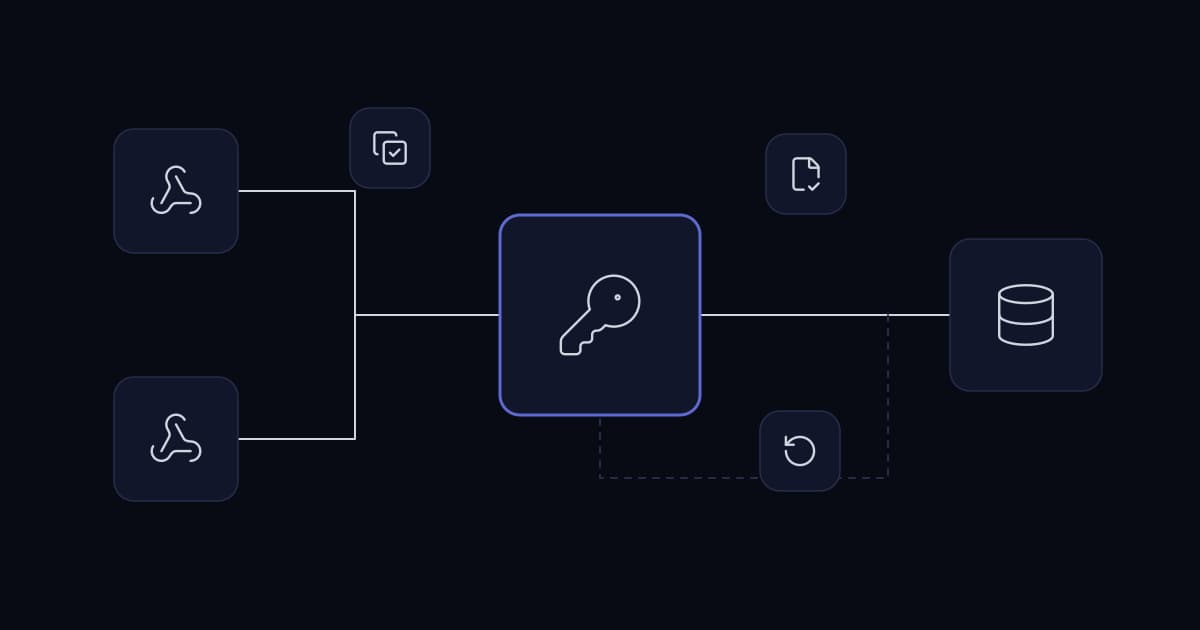
A workflow creates a customer task, then loses the connection before it receives confirmation. The execution shows a failure. An operator retries it, and the CRM now contains two tasks.
The first failure was a missing response, not necessarily a failed business action. That distinction is the foundation of reliable automation.
For n8n workflows that write to business systems, give each intended operation a stable identity, record confirmed results and reconcile uncertain outcomes before replaying them. Retry configuration is useful, but it does not create end-to-end idempotency by itself.
Define the operation before the workflow
A workflow execution can contain several operations: read a source event, create a CRM record, send a notification and update a reporting table. Each may have a different recovery requirement.
Define the business action that must not happen twice. It might be creating one callback for one call, issuing one notification for one approved change or applying one synchronized update.
Do not use the workflow execution identifier as the only operation identity if a retry creates a new execution. The business operation needs to remain recognizable across attempts.
Identical data does not always mean duplicate intent
Two customers can legitimately submit identical requests. The same customer can request the same service twice. Hashing the entire payload without considering intent may incorrectly discard valid work.
Prefer a stable source event or business operation identifier where available. Include the relevant tenant or source boundary so identifiers from different systems do not collide.
Understand idempotency precisely
An idempotent operation can be repeated without producing additional unintended effects for the same intended operation. The target API's contract determines how its idempotency mechanism behaves, including the scope and retention of keys.
AWS's treatment of idempotent APIs illustrates the value of caller-provided request identifiers and the ambiguity caused by timeouts. It also explains why superficially identical requests can represent different intent.
Reference
- AWS Builders' Library: Making retries safe with idempotent APIs— Background on request identity and safe retry semantics.
Do not claim exactly-once business behaviour merely because the workflow platform has a queue. The complete path includes the target system and the persistence of the operation record.
Store a small operation ledger
A durable ledger can record the operation key, source event, payload version, state, attempt count and downstream result identifier. Use a uniqueness constraint appropriate to the business key.
Possible states include received, validated, submitted, confirmed, uncertain and failed for review. Make the distinction between uncertain and confirmed failure explicit.
Store only the fields needed for recovery and audit. The ledger does not need to become another uncontrolled copy of all customer data.
| Ledger field | Purpose | Common mistake |
|---|---|---|
| Operation key | Recognize the intended action across attempts | Generate a new key for every retry |
| Source reference | Find the originating event | Store only a transient execution URL |
| Payload version | Detect changed intent | Reuse a key for materially different data |
| State | Decide the next permitted step | Treat timeout as confirmed non-execution |
| Target record ID | Reconcile completed work | Ignore the successful downstream identifier |
Put the duplicate check where it can hold
A “look up, then create” sequence can race when two workers handle the same event. Both can observe that no record exists and both can create one.
Use an atomic claim or uniqueness mechanism where the application architecture supports it. At the target, use its documented idempotency facility when available.
A local lock alone cannot prove whether an external side effect completed before a worker failed. Combine concurrency control with a durable result record and a recovery policy for uncertain outcomes.
Keep transactions within their actual boundary
A database transaction can protect changes inside that database. It does not automatically include an external CRM API or email service.
Do not describe a local transaction as making the entire distributed workflow atomic. Design the cross-system steps explicitly.
Classify retryable conditions
Temporary connectivity problems and provider throttling may be candidates for bounded retries. Invalid payloads, missing permissions and unsupported operations usually require correction.
Follow the target API's current error semantics and retry guidance. Add a total deadline or attempt budget so the workflow cannot loop indefinitely.
Avoid retries at every layer without coordination. A connector, application wrapper and workflow may each repeat the same operation, multiplying attempts unexpectedly.
For consequential writes with an unknown result, reconcile before retrying unless the target's idempotency contract safely covers the operation.
Handle partial completion
Suppose a workflow creates a CRM task successfully but fails while updating an internal report. Replaying the entire workflow should not create another task.
Resume from the confirmed state and retry the incomplete reporting operation. Preserve the successful task identifier in the operation record.
If the business needs to reverse an earlier action, define a compensating action with its own authority and evidence. Compensation is not always a literal undo, especially after a message has been delivered or a customer has acted on it.
Make irreversible steps late when practical
Validate data and permissions before sending external messages or applying consequential changes. A workflow that performs an irreversible action first has fewer safe recovery options.
The order should follow business requirements, but it should be deliberate. Convenience in a visual editor is not a sufficient reason to send before validating.
Create an exception queue people can use
When automatic recovery is unsafe, place the operation in a review queue with the source reference, intended effect, known outcome and recommended investigation.
Do not ask the operator simply to “retry failed executions.” Show which side effects may already have occurred.
Allow controlled actions such as confirm an existing target record, correct the payload or cancel the operation. Record the decision so the next worker does not rediscover the same uncertainty.
Replay with current authority and original intent
A replay performed later must still respect the current business state. The source event may be obsolete, the customer may have cancelled or the integration's permission may have changed.
Separate a retry of the same intended action from a new action based on corrected data. Reusing an idempotency key for changed intent can lead to confusing or rejected results, depending on the target contract.
Keep a readable history linking the original event, correction and subsequent operation. This helps support explain why a result differs from the initial request.
Test failure between the steps
Do not test only a clean end-to-end run. Stop the worker after submission but before confirmation is recorded. Deliver the same event twice. Run two workers against the same operation.
Make the target return a validation error, a temporary failure and an uncertain timeout. Check that each condition reaches the correct state and does not trigger the same recovery blindly.
Inspect the business systems after the test. A workflow marked successful can still have duplicated a side effect, while a workflow marked failed may have completed one important step.
Include delayed events
An old event may arrive after a newer update. Define whether it should be ignored, reconciled or applied according to a version rule.
Do not assume that event delivery order matches business chronology. Use source versions or timestamps only where their semantics are reliable and documented.
A hypothetical callback workflow
A call platform emits a completed-call event and an n8n workflow prepares a callback task for cases meeting an approved rule.
The operation key combines the source call identity, tenant and callback purpose. The workflow claims the operation, validates the target customer and requests task creation through the approved API.
If the response is lost, the ledger marks the outcome uncertain. The recovery path checks for the task using the operation reference rather than creating another one immediately.
Once the target task identifier is confirmed, a separate reporting step records completion. A later reporting failure can be retried without repeating task creation.
Keep AI out of deterministic recovery decisions
An AI step may classify a case or draft a note, but it should not guess whether a downstream transaction happened. Use the target system's records and the operation ledger.
Preserve the approved AI output for the intended action rather than regenerating it on every retry. A regenerated draft may change the payload and therefore the meaning of the operation.
If the output needs correction, treat that as a versioned change with the appropriate review, not a hidden side effect of recovery.
Operate the workflow over time
Monitor uncertain operations, exception-queue age, repeated attempts and duplicate-prevention events. A growing queue may indicate a downstream change rather than a temporary outage.
Assign an owner for target API changes, credentials and replay procedures. Keep platform-version-specific settings in the deployment runbook and verify them against the version actually installed.
This guide describes an architectural pattern around n8n. It does not assume that a particular node setting provides the complete ledger or transaction semantics automatically.
Trace a duplicate through the receiving system
Imagine a workflow receiving an order event twice because the sender did not receive an acknowledgement. Both events refer to the same business operation. The workflow should identify that relationship before creating another record or sending another customer notification.
Decide which identifier represents the operation. A delivery attempt identifier may change on every retry, so it may be unsuitable as the deduplication key. An order identifier alone may be too broad if the same order legitimately has several different operations. The key should match the business effect being protected.
Store the relationship between the key, intended request and confirmed result in a durable place. If a later request reuses the key with different meaningful data, treat that as a conflict to investigate rather than assuming it is an identical retry.
The downstream system still matters. If it supports idempotency, use the documented contract and understand its scope and retention behavior. If it does not, design reconciliation around the records it can expose. A local flag cannot prove that a remote write failed after an ambiguous timeout.
Separate scheduling from business truth
The workflow engine knows which steps it attempted. The system of record knows which business changes it accepted. Recovery often requires comparing both. Keep enough correlation information to connect an execution to its downstream effect.
For example, a workflow may time out after sending a request to create a support case. Before creating another case, query by a stable reference if the destination supports that operation. If the result cannot be established reliably, route the task for reconciliation instead of guessing.
Do not use an arbitrary delay as proof that a previous attempt did not complete. Waiting can reduce some timing problems, but it cannot resolve every ambiguous outcome. The recovery rule needs evidence from the operation or destination.
Make replay a controlled operating action
An operator should understand what will happen before replaying a failed workflow. Show the last confirmed stage, protected operation key and any known downstream result. A large “retry all” action deserves particular care when the queue contains external writes.
Define who may replay tasks and which changes are permitted first. Editing a payload can turn a retry into a new business operation. Preserve the original attempt and record the reason for any correction so the history remains understandable.
Test replay after a workflow version changes. A task created under an older schema may not be safe to run through the latest logic without migration or review. Version the information needed to interpret the pending work.
Include duplicate deliveries, out-of-order events and a crash between the remote write and local confirmation in commissioning exercises. These scenarios reveal defects that a successful single execution cannot show.
For a workflow reliability review, provide the event source, destination APIs and examples of repeated or uncertain outcomes. Include the records available for reconciliation. KYCONNECTS can help design the integration around durable state and recoverable actions; installing an automation platform alone does not establish these guarantees.
The operating objective is straightforward: repeated delivery should not create repeated business effects, and uncertainty should remain visible until it is resolved. That objective belongs to the complete integration, even when n8n coordinates the individual steps.
Questions about workflow reliability
Does enabling retries prevent duplicate records?
Retries repeat requests; they do not by themselves prevent duplicate business effects. Use stable operation identity and the target's supported idempotency or reconciliation mechanism.
Is a workflow queue an exactly-once guarantee?
A queue does not automatically guarantee exactly-once effects across external systems. Design and verify the complete path, including target behaviour and durable operation records.
Should every failed execution be replayed?
Replay only after determining which steps completed, whether the intended action remains valid and whether repeating it is safe. Uncertain side effects need reconciliation first.
Reference
- Monitoring and automation services— Build recovery and operational ownership into automation.
- CRM integration best practices— Define field ownership and event behaviour before connecting systems.
- AI provider outage planning— Handle dependency failures without losing business state.
Discuss your requirements
- Review workflow retry reliability— Describe the event source, destination systems and repeated or uncertain business outcomes.
Services This Relates To
Written by KYCONNECTS Engineering. Client names are withheld under confidentiality.