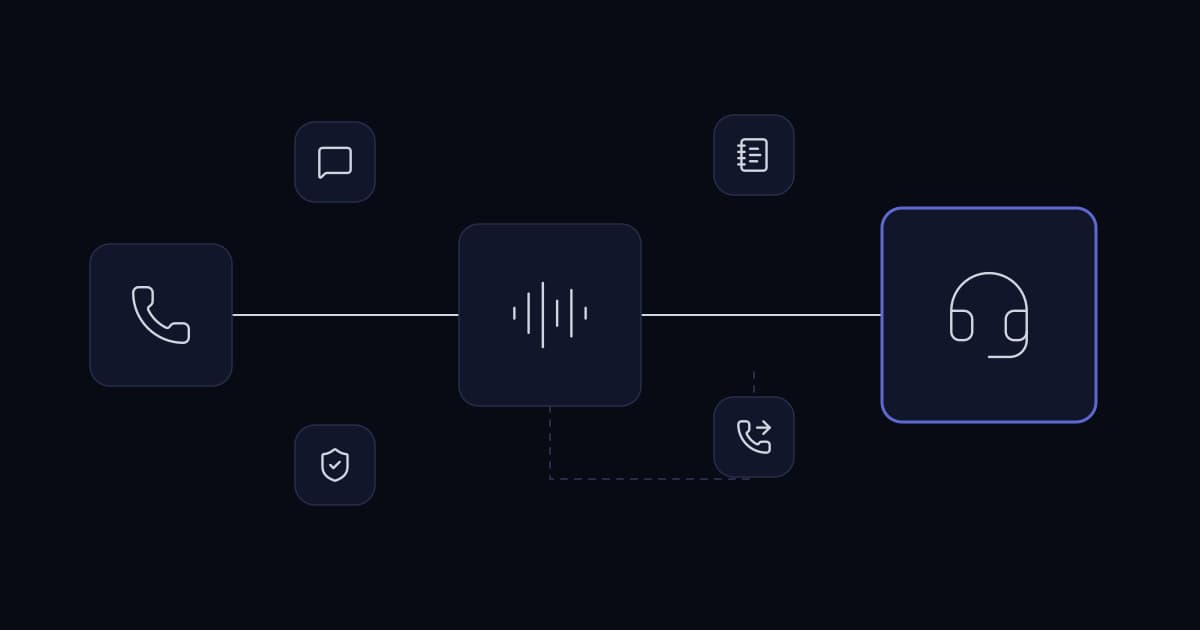
The assistant says it is transferring the call. The API accepts the request. The customer hears ringing, then silence. In the operations dashboard, the interaction has already been counted as successfully handled.
A voice AI handoff is complete only when the intended destination has actually taken over according to the call platform's observable state. Requesting a transfer is one step, not proof of the outcome.
Design the human path before expanding the assistant's duties. It needs an available destination, enough context for the next person and a defined response when the transfer fails.
Decide when the assistant should stop
Some callers explicitly ask for a person. Others reach a point where the assistant lacks evidence, authority or a suitable supported process.
Define escalation conditions with the service team. They can include repeated misunderstanding, an unsupported request, a sensitive complaint or a required business decision outside the assistant's authority.
Do not make the caller complete an unnecessary sequence before reaching a person. A self-service path should help resolve a problem, not become an obstacle to the staffed service.
Avoid using sentiment as the only trigger
A caller can be calm while facing an urgent issue, or frustrated about a routine one. Emotion inferred from speech is not a reliable substitute for understanding the request and the available service policy.
Use explicit request content, failed progress and known business conditions. Let a human review situations the automation cannot handle confidently within its approved scope.
Model the handoff as a state transition
Useful states include escalation requested, destination selected, transfer submitted, destination ringing, connected to human and transfer failed. The exact events depend on the PBX, carrier and provider.
Map those events to a common application record. Do not assume that an HTTP success response means the customer reached an agent.
OpenAI's telephony documentation provides a concrete example: its refer operation returns success when the SIP REFER has been relayed to the SIP provider, while the downstream system handles the remaining call flow. That is an important boundary to preserve in reporting.
Reference
- OpenAI: Telephony and SIP— Transfer submission and downstream call handling are distinct stages.
Confirm the destination can help
Route to a queue or destination that matches the request and operating hours. A technically valid number can still lead to a closed department or another automated menu.
Keep routing policy in the application or telephony configuration. The model should not invent a destination or select an arbitrary number from a caller's statement.
Check what the receiving team can access. A handoff to someone without the relevant customer context may simply restart the same investigation.
Plan for no available agent
Decide whether the caller should remain in a queue, receive an approved callback option or use another staffed route. Make the available choice clear without promising a response time the operation cannot meet.
If a callback is offered, treat its creation as a separate business action with a confirmed record. A spoken promise alone does not create a callback task.
Transfer context without transferring assumptions
The next agent needs a concise account of the caller's request, confirmed facts, actions already taken and unresolved questions. Keep generated interpretations distinguishable from verified records.
Include the relevant case identifier and call correlation identifier. Do not pass a long unstructured transcript as the only handover artifact.
If the assistant attempted an action whose result is uncertain, say so explicitly. A human who believes a refund or booking already happened may create a duplicate or give incorrect advice.
| Handoff field | What belongs there | What to avoid |
|---|---|---|
| Request | Caller-stated goal | Inferred motivation |
| Identity status | Verification steps actually completed | Assuming caller ID proves identity |
| Evidence | Relevant confirmed account or case facts | Unsupported summary claims |
| Actions | Completed operations with identifiers | Proposed steps described as completed |
| Open issue | Specific reason for escalation | Generic “customer unhappy” label |
Keep identity checks intact
A phone number can help find a possible account, but it should not by itself authorize disclosure or a sensitive account change. Preserve the existing identity-verification process.
Tell the receiving agent which checks were completed and which were not. Do not collapse several different verification states into a single “verified” flag unless the business policy supports that simplification.
If the caller changes the requested account during the conversation, re-evaluate the relevant boundary. The model's conversational continuity must not carry authority from one record to another.
Decide between transfer patterns deliberately
Telephony platforms can support different transfer and bridging behaviours. The appropriate pattern depends on whether the assistant should remain involved, whether context is presented separately and how the receiving destination confirms acceptance.
Test the chosen behaviour on the actual carrier and PBX route. A transfer that works in a browser demonstration may behave differently through an external trunk or a remote agent queue.
Document who owns the call during each stage. That ownership determines who can play a message, recover from failure or end the assistant's participation.
Avoid two systems speaking at once
The customer experience becomes confusing if the assistant keeps talking while a queue announcement or human agent begins. Coordinate media and call-state handling according to the platform's supported events.
Test interruption, silence and delayed event delivery. The system should not depend on every event arriving instantly or in the most convenient order.
Preserve a safe path during provider failure
If the AI service becomes unavailable, the telephony system should have a defined route to the established customer-service process where appropriate.
Keep essential routing independent of the model's ability to generate a response. An unavailable model should not trap the caller in silence while the application retries.
The fallback must respect operating hours, queue capacity and the business's existing treatment of urgent or special-purpose calls. This article does not replace the organization's requirements for emergency or regulated communications.
Measure handoff quality as an outcome
Count requested transfers, confirmed connections, failed transfers and caller abandonment separately. A high transfer-request count does not establish a good escalation experience.
Measure whether agents receive useful context and whether callers have to repeat the entire request. Use sampled review to identify missing fields and unsupported summaries.
Track the reason for escalation. If many calls reach a person because the assistant lacks one piece of accessible information, improving that retrieval may help. If they require discretionary decisions, the handoff may be working exactly as intended.
Test with realistic call conditions
Use test calls covering accents, background noise, interruptions and callers correcting earlier information. These are ordinary operating conditions, not unusual edge cases.
Exercise destinations that are busy, closed, unanswered or unavailable. Test what the caller hears and what the support record says afterwards.
Check duplicate callback creation and interrupted transfers. An application restart during the handoff should not leave the operations team unable to determine whether the caller reached anyone.
Include the receiving team in acceptance
VoIP engineers can verify signaling and media. Agents can judge whether the transferred context is usable. Supervisors can assess whether the queue policy makes sense.
A complete acceptance test needs all three perspectives. A technically successful call can still produce a poor service handover.
A hypothetical after-hours workflow
A business uses a voice assistant to collect the purpose of an after-hours support call and find the applicable service route. The assistant can answer a narrow set of approved questions.
When the request needs a person, the application checks the agreed after-hours routing policy. If a staffed destination is available, it submits the transfer and tracks the downstream outcome.
If no destination answers, the workflow follows the approved fallback rather than declaring the issue resolved. Any callback request is saved with a reference, and the caller receives only the confirmation that the system can substantiate.
The next working team sees the original request, attempted routing and confirmed record state. It does not inherit an optimistic “handled by AI” label.
Keep call data governed
Audio, transcripts and handoff summaries can contain sensitive information. Define what is collected for the workflow, who can access it and how long it is retained.
Recording and processing obligations vary by jurisdiction and use case. Review the intended deployment with the appropriate legal and privacy owners rather than copying another business's announcement or retention period.
Apply access controls to the handoff summary as well as the audio. A short summary can still disclose the most sensitive part of a conversation.
Rehearse a transfer as a customer journey
Start a test call with a realistic business request and deliberately trigger the handoff condition. Follow the caller through the full transition. Listen for the announcement, waiting experience and moment a person becomes available. Check the receiving agent's screen as well as the telephone connection.
The receiving agent should see a concise account of the caller's request, any verified details and the reason for transfer. Separate confirmed information from the assistant's interpretation. A summary that confidently states an unverified account change can create more work than a short transcript reference.
Test whether the caller must repeat information that the system already collected appropriately. Some repetition is necessary for identity verification or sensitive decisions. Other repetition may indicate that the context transfer failed. The design should distinguish those cases instead of promising a completely frictionless handoff.
Also test what happens when the receiving queue answers with another automated system. A signaling event or answered call does not necessarily mean a qualified employee is handling the request. Define the completion evidence that the business actually needs.
Design the unsuccessful path with equal care
If the destination is unavailable, keep the caller informed and offer the approved alternatives. These might include a staffed queue, a callback request or another contact channel. Which alternatives are appropriate depends on the service and its operating hours.
A callback request is a business record that needs ownership. Capture the permitted contact details, reason and requested timing. Confirm only what the organization can support. Do not let the assistant promise a response deadline that no team has agreed to meet.
Prevent transfer loops. If the assistant and a downstream queue repeatedly send the same caller back to one another, the system needs a termination rule and an observable failure state. Include this scenario in testing even if each individual route appears correct.
For sensitive cases, decide whether the assistant should stop collecting information while the handoff is unresolved. Continuing to ask questions can create an impression that the problem is being handled when no qualified recipient is available.
Agree on launch evidence with operations
Before launch, the communications owner and receiving team should review completed and failed test calls together. Confirm that the queue behavior, context package and escalation rules match the operating process. A telephony configuration review alone cannot establish that the handoff works for staff.
Include calls with silence, interruptions, unclear speech and a caller who changes the request midway. Use approved test participants and data. The purpose is to examine whether the system preserves the caller's intent and reaches an appropriate destination under ordinary variation.
Keep a small regression set for later routing or model changes. Review both the audio experience and the recorded business outcome. A change that sounds more natural can still omit a critical handoff detail or create an incorrect callback record.
For a voice integration discussion, provide the current call flow, queue ownership, business hours and the situations that require a person. Include the telephony platform and any CRM that should receive context. These details determine the integration scope more reliably than a list of desired voice personalities.
KYCONNECTS can help connect the communications path to the business workflow. The useful outcome is a caller who reaches the right next step with an accurate record, including when automation has reached its limit.
Handoff questions
Does a successful transfer API response prove a human answered?
A successful API response can confirm only that a transfer request was accepted or relayed. Use the downstream telephony events required to establish that the intended human destination connected.
Should the assistant decide the transfer number freely?
Transfer destinations should come from an approved routing policy. A model-generated or caller-supplied number should not bypass the application's destination controls.
What if the receiving agent has no time to read the transcript?
Provide a short structured handoff with the request, confirmed facts, completed actions and unresolved issue. Keep the source transcript available only where access and policy permit.
Reference
- Communications services— Design routing, queues and operational handovers.
- AI-powered customer support— Decide which parts of customer support should be automated.
- Call recording compliance— Review the separate requirements around retained call content.
Discuss your requirements
- Plan a voice AI handoff— Share your call flow, queue ownership and the situations that require a person.
Services This Relates To
Written by KYCONNECTS Engineering. Client names are withheld under confidentiality.