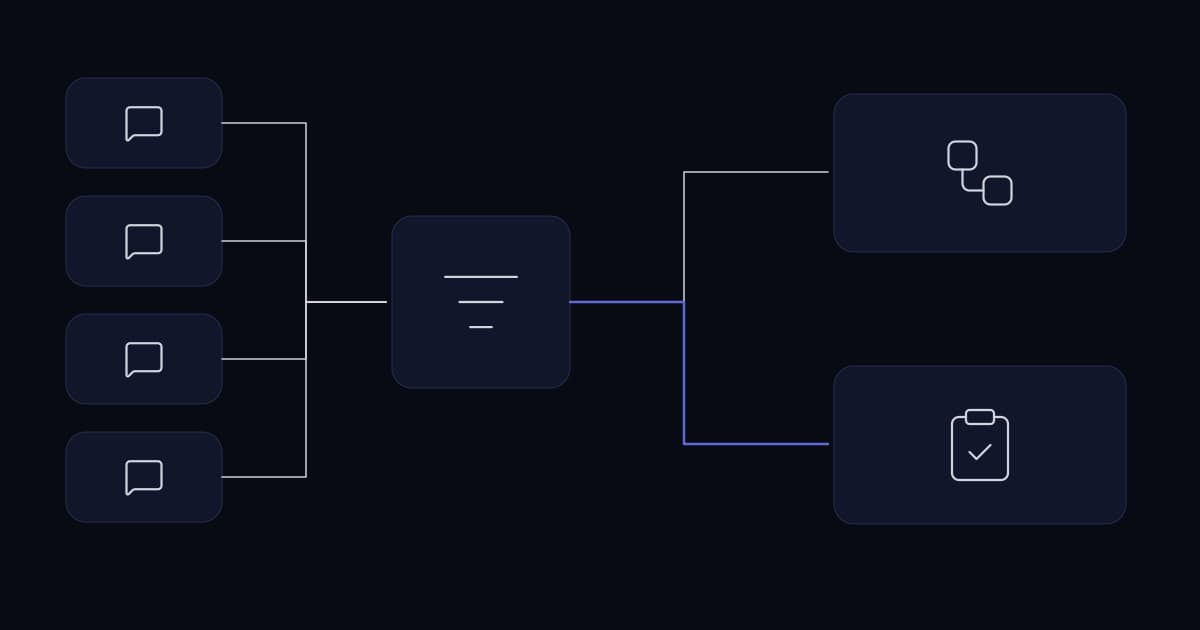
Most support operations that struggle are not struggling for lack of automation. They are struggling because the answer a customer needs exists in three places that disagree, because the agent cannot see what the customer already tried, or because the same question arrives two hundred times a month and nobody has written it down. Those are process and knowledge problems, and they were there before anyone proposed AI.
The business impact of adding AI on top of that is specific and worth stating plainly. A support operation with poor knowledge produces slow, inconsistent answers, which customers experience as frustrating. The same operation with AI on top produces fast, confident, inconsistent answers, which customers experience as untrustworthy. The second is worse, because a slow answer prompts a follow-up question and a confident wrong one does not.
This article treats AI as one component in a support architecture that also contains a CRM, a helpdesk, a knowledge base, a phone system and people. The people do not go away, and designing as though they will is the most common and most expensive mistake in this category.
Where AI belongs in a support operation
Support is not one activity. It is at least five, and AI is well suited to some of them and badly suited to others. Separating them is the fastest way to stop arguing about whether to use AI and start deciding where.
| Activity | What it involves | AI suitability |
|---|---|---|
| Deflection | Answering a question the documentation already answers | High, and only as high as the documentation |
| Triage and routing | Classifying an incoming contact and sending it to the right queue | High. Low risk, easily measured, reversible |
| Context assembly | Gathering account history, prior tickets and entitlement before an agent responds | High. Retrieval and summarisation, with a person verifying |
| Drafting a response | Composing a reply for an agent to review, edit and send | High, with the agent as the verification step |
| Judgement | Goodwill decisions, exceptions, anything involving a commercial relationship | Low. The decision belongs to a person |
The two rows in the middle are where most of the unglamorous value sits, and they are the ones proposals skip because they do not demonstrate well. Triage and context assembly reduce handling time on every contact, including the ones AI will never resolve, and their failure mode is a misrouted ticket rather than a wrong answer to a customer.
Customer-facing AI versus agent assist
These are usually presented as a maturity ladder: start with agent assist, graduate to customer-facing once you trust it. That framing is wrong, and it leads businesses to treat a permanent design choice as a temporary phase.
The real distinction is where verification happens. In agent assist, a trained person reads the output before the customer sees it, which means a wrong answer costs a few seconds of that person's attention. In customer-facing AI, the output reaches the customer unverified, which means a wrong answer costs whatever a wrong answer costs in your business. For a great many operations, keeping a human in that path is not training wheels. It is the correct permanent architecture.
| Agent assist | Customer-facing | |
|---|---|---|
| Who verifies | A trained agent, every time | Nobody, unless escalation triggers |
| Cost of a wrong answer | Seconds of agent time | Whatever a wrong answer costs your business |
| Effect on headcount | Same agents handle more contacts | Fewer contacts reach agents at all |
| Knowledge gaps show up as | Agent edits the draft | Customer receives something wrong |
| Appropriate when | Answers carry commercial, safety or compliance weight | Questions are high-volume, low-stakes and well documented |
| Realistic starting point | Almost always | After deflection questions are proven safe in agent assist first |
A practical sequencing point follows from the last row. Running a capability in agent assist first is not only safer, it produces the dataset you need to justify customer-facing deployment: the rate at which agents send the draft unchanged. A capability accepted unedited nine times in ten is a candidate for customer-facing use. One that is edited most of the time is telling you the knowledge behind it is not ready.
When AI should answer, and when it should stop
This is where most published advice goes wrong, and it is worth being direct about why.
The confidence threshold problem
The standard recommendation is to set a confidence threshold and escalate below it, usually with a specific percentage attached. Those numbers circulate widely and none of them trace to a source. More importantly, the advice is frequently unimplementable: a language model generating an answer does not emit a calibrated probability that the answer is correct. It produces fluent text with the same fluency whether the retrieved material supported the answer or not. There is no dial labelled confidence on most of these systems, and where a score exists it usually measures retrieval similarity rather than answer correctness.
What is actually implementable is a set of observable conditions. These do not require the model to know anything about its own reliability, which is the property that makes them work.
| Trigger | Signal | Why it works |
|---|---|---|
| Customer asks for a person | Explicit request in the message | Never negotiate this. Refusing or delaying is the single fastest way to lose trust in the whole system |
| Retrieval returned nothing relevant | No source document met the retrieval threshold | Measurable before generation. If nothing was found, do not generate — say so and hand off |
| The topic is on the restricted list | Intent classification against a defined list | Billing disputes, cancellations, complaints, anything legal or safety related |
| The customer has asked twice | Repeat or rephrased question in the same conversation | A second attempt means the first answer failed, whatever the system thinks |
| The account is flagged | Attribute on the CRM record | High value, at-risk or under complaint accounts route to a person by policy |
| Sentiment has deteriorated | Classification over the conversation | Useful as a supporting signal; weak on its own and should never be the only trigger |
The second row is the one that does most of the work and is most often omitted. Checking whether retrieval found anything relevant happens before the model is called, is cheap, and catches the failure mode that matters most: a question your documentation does not cover. A system that says it does not know and connects the customer to someone who does is behaving correctly. A system that generates a plausible answer from nothing is not.
What a handoff must carry
The handoff is where support AI most visibly succeeds or fails, and the failure is always the same: the customer explains the problem again. Having already explained it once, being asked to repeat it is worse than never having been offered the AI at all.
- The full conversation transcript, visible in the agent's normal interface rather than a separate tool.
- What the AI attempted and which sources it used, so the agent does not repeat a failed suggestion.
- Why it escalated, as a named trigger rather than a generic failure.
- The customer record and recent ticket history, already loaded.
- The queue position or wait, communicated honestly at the point of handoff.
The first item is a genuine integration requirement rather than a nice-to-have. If the transcript lands somewhere the agent must go and fetch, under time pressure they will not fetch it, and the customer will be asked to repeat themselves regardless of what the architecture diagram says.
Knowledge quality matters more than model quality
An AI support agent answers from your content. It cannot answer what your documentation does not contain, and it cannot tell that your documentation is out of date. The general principle — that retrieval sets the quality ceiling — is covered in the AI integration article. What is specific to support is that the corpus is not static, and the support function is the only part of the business that both consumes it and continuously generates the material to improve it.
Measure coverage before deploying
Take the top thirty ticket subjects from the last quarter. For each, check whether a documented answer exists and whether it is current. That fraction is the realistic ceiling on deflection, it takes an afternoon to establish, and it is a far better predictor of outcome than any evaluation of models.
Two failure patterns show up in this exercise repeatedly. The first is coverage that exists but is written for the wrong reader: internal documentation that assumes knowledge a customer does not have, which produces technically accurate answers that do not help. The second is contradiction — the same question answered differently in a help centre article, a support macro and a product page. A person resolves that by knowing which source is current. A retrieval system cannot, and will confidently pick one.
Make resolved tickets feed the knowledge base
Every ticket a human resolves that the AI could not is a documented gap with the answer already attached. Most operations discard that. Routing those cases into a weekly review, where somebody decides whether the answer belongs in the knowledge base, turns support into the mechanism that improves its own automation.
This is an operational process, not a technical one, and it needs a named owner and a slot in the week. Without it, deflection performance peaks shortly after launch and then declines as the product changes and the documentation does not — a decline that is slow enough to be attributed to the model rather than to the corpus.
Understand what your vendor means by a resolution
Support AI is increasingly sold per outcome rather than per seat, which sounds straightforwardly aligned with your interests. It is worth reading the definitions, because the same word means materially different things across vendors, and one common definition counts a customer giving up as a success.
| Vendor | Unit | Definition as documented |
|---|---|---|
| Zendesk | Automated resolution | Counted when a customer's issue is successfully resolved without live-agent intervention, subject to an LLM verification that the request was actually satisfactorily resolved; conversations failing verification are not counted |
| Intercom | Resolution | Counted when, following the AI's last answer, the customer either confirms the answer was satisfactory (confirmed resolution) or exits the conversation without requesting further assistance (assumed resolution) |
| Freshworks | Session | Counted when a unique user interacts with an AI Agent within a 24-hour window, regardless of outcome |
| HubSpot | Credits | Credits are required for usage-based features including Customer Agent, and are consumed when specific actions are performed; consumption rates are published in a separate rate sheet |
The second row deserves attention. An assumed resolution is a customer who received an answer and left. Sometimes that is a satisfied customer. Sometimes it is a customer who gave up and went to a competitor, and from the conversation log those two are indistinguishable. Zendesk's approach of running a verification step is a direct attempt to address this, and Freshworks bills per interaction window rather than per outcome, which is at least unambiguous about what is being charged for.
None of these vendors is behaving unreasonably; measuring resolution automatically is genuinely hard. The practical consequence is that the vendor's resolution count should not be your success metric. Track it for the invoice, and measure outcomes separately with something the vendor does not bill on — repeat contact rate within seven days is the most useful single number, because a customer who comes back was not resolved regardless of what the log recorded.
Integrating with CRM, helpdesk and phone systems
The integration work is ordinary integration work, subject to the same practices as any other: field ownership, duplicate handling, credential lifecycle, monitoring. Those are covered in the CRM and API integration articles. What is specific here is which system owns what, and getting that wrong produces a support AI that answers questions correctly and still fails.
| System | Owns | Provides to the AI layer | Must not be overwritten by it |
|---|---|---|---|
| CRM | Customer identity, entitlement, account flags | Who this is, what they are entitled to, whether the account needs special handling | Anything a human maintains: contact details, account status, commercial terms |
| Helpdesk | Tickets, conversation history, queues, SLA state | What this customer has asked before and what was done | SLA timers and assignment, unless routing is deliberately delegated |
| Knowledge base | The documented answers | The retrieval corpus | Article content — AI proposes updates, people approve them |
| Phone system | Calls, recordings, queue state | Transcripts and call outcomes | Call routing during live calls, unless explicitly designed for it |
Voice is a different problem
Voice is usually treated as another channel, and it behaves differently enough to deserve separate design. Speech recognition introduces an error before the model sees anything, and that error is invisible downstream: a misheard account number produces a confidently wrong answer to a question the customer never asked. There is no scrollback, so a customer cannot re-read what was said. And latency is unforgiving — a pause that reads as thoughtful in chat reads as a dropped call on the phone.
The consequence is that the safe applications on voice are narrower. Transcription and post-call summarisation written back to the customer record are reliable and valuable, and they are the ones we deploy most often, because the transcript is reviewed rather than acted on in real time. Identification and routing based on what the caller says are reasonable with a confirmation step. Fully automated resolution of a substantive question by voice deserves a much higher bar than the same question in chat.
On the integration side, Asterisk-based platforms such as FreePBX, along with 3CX and Vicidial, expose call events and recordings, which is what a summarisation pipeline needs. The pattern is the same as any other CRM-telephony integration: an event on call completion, a transcript, a summary, and a write-back to the customer record through the CRM's own API.
Multi-channel means one conversation, not four bots
A customer who asks in chat, gets nowhere, and emails the next morning is having one conversation. If the email arrives with no knowledge of the chat, the AI will offer the same answer that already failed. Channel unification is a helpdesk and identity problem rather than an AI one, and it is worth resolving before adding AI, because AI makes the failure faster and more visible.
Privacy, security and governance
Support is the highest-exposure place to deploy AI in most businesses, for a reason that is easy to miss: it is the one function where untrusted external text is fed directly into a system that has authenticated access to customer records. Every other internal deployment reads content the business controls.
The OWASP Top 10 for Large Language Model Applications, 2025 edition, names the relevant risks. Three apply with particular force in support.
| Entry | Why support is exposed |
|---|---|
| LLM01: Prompt Injection | The input is a message written by a member of the public. Instructions embedded in a ticket or email must be treated as untrusted content, never as instructions to follow |
| LLM02: Sensitive Information Disclosure | One customer's data must never surface in another's conversation. Scope retrieval to the authenticated customer at query time, not by filtering afterwards |
| LLM06: Excessive Agency | A support assistant needs to read the account and create tickets. It does not need to issue refunds, change contact details or close accounts |
The second is the one to design for first, and it is an architectural constraint rather than a prompt instruction. Telling a model not to reveal other customers' data is not a control; retrieving only the authenticated customer's records is. If the system can retrieve it, it can disclose it, and the defence has to sit at the retrieval layer.
For the governance frame around this, the NIST AI Risk Management Framework provides the structure, and the specific question of whether vendor data terms permit customer data to be processed by a given service is covered in the AI integration article. One support-specific addition: because support handles personal data by definition, the data-processing terms of the AI vendor become part of your own processing position, and that belongs in the assessment before deployment rather than after.
A representative scenario
A composite of situations we see repeatedly; no client detail is included.
A company with a small support team deploys a customer-facing AI assistant on its help centre, aiming to reduce ticket volume. Volume falls immediately and the deployment is judged a success. Two months later, ticket volume is back where it started and satisfaction has fallen.
The review found three causes. Deflection was measured as tickets not created, which counted every customer who read an unhelpful answer and gave up alongside every customer genuinely helped. The assistant had no access to account data, so any question that depended on the customer's own situation received a generic answer that was accurate and useless. And roughly a third of the help centre predated a significant product change, so a meaningful share of confident answers described behaviour that no longer existed.
The remediation was mostly not technical. Documentation for the top thirty ticket subjects was reviewed and corrected first. The assistant was connected to the CRM so it could scope answers to the authenticated customer, with retrieval restricted to that customer's records. Escalation was rebuilt around observable triggers, with the transcript and attempted sources passed into the agent's normal queue. Deflection was replaced as the headline metric by repeat contact rate within seven days.
The measured deflection number after these changes was lower than the original figure. It was also true, which is what made the subsequent improvements meaningful rather than notional.
Implementation checklist
- Coverage has been measured: for the top thirty ticket subjects, a current documented answer exists and is written for the customer rather than for staff.
- Contradictions between the help centre, macros and product documentation have been resolved, with one source designated as current.
- The capability runs in agent assist first, with the unedited-send rate recorded before any customer-facing deployment.
- Escalation triggers are observable conditions, not a confidence percentage, and an explicit request for a person always escalates immediately.
- Retrieval is checked before generation, and a query that finds nothing relevant produces a handoff rather than an answer.
- The handoff carries the transcript, the attempted sources and the escalation reason into the agent's normal interface.
- Retrieval is scoped to the authenticated customer at query time; a customer's records are unreachable from another customer's conversation.
- The integration can read the account and create tickets, and cannot issue refunds, change contact details or close accounts.
- Conversation retention has a defined period, access model and deletion path.
- The vendor's definition of a resolution has been read, and success is measured separately using repeat contact rate.
- Tickets the AI could not resolve route to a weekly knowledge review with a named owner.
Frequently asked questions
What is AI-powered customer support?
AI-powered customer support is the use of artificial intelligence as a component within an existing support operation, alongside the CRM, helpdesk, knowledge base, phone system and human agents rather than in place of them. In practice it covers several distinct activities: answering documented questions without an agent, classifying and routing incoming contacts, assembling account context before an agent responds, drafting replies for an agent to review, and summarising calls. The AI answers from the organisation's own content and records, which means its accuracy is limited by how complete and current that material is rather than by the capability of the model.
What is the difference between agent assist and a customer-facing AI agent?
The difference is where verification happens. In agent assist, the AI drafts a response or assembles context and a trained agent reviews it before the customer sees anything, so a wrong answer costs a few seconds of that agent's attention. With a customer-facing agent, the output reaches the customer without review, so a wrong answer carries whatever cost a wrong answer carries in that business. Agent assist is often treated as a temporary stage before customer-facing deployment, but for answers with commercial, safety or compliance weight, keeping a person in the verification path is the correct permanent design rather than an interim measure.
How do you decide when AI should escalate to a human?
Use observable conditions rather than a confidence percentage. Language models generating support answers do not typically produce a calibrated probability that the answer is correct, so a threshold expressed as a percentage is often unimplementable, and the specific figures that circulate are not traceable to a source. Conditions that can actually be implemented include: the customer explicitly asking for a person, which should always escalate immediately; retrieval finding no relevant source document, which is checkable before the model is called; the topic appearing on a restricted list such as billing disputes or cancellations; the customer asking the same question a second time; and the account carrying a flag such as high value or under complaint.
Why does AI customer support give wrong answers?
The most common cause is not the model but the material it was given. An AI support agent answers from the organisation's documentation and records; where those are missing, outdated or contradictory, it produces a fluent answer built on the wrong source. Support content is particularly prone to this because products change and documentation lags, and because the same question is often answered differently in a help centre article, an internal macro and a product page. A retrieval system cannot tell which of those is current and will select one. The practical safeguard is to check whether retrieval found anything relevant before generating, and to hand off rather than answer when it did not.
How is AI customer support priced, and what counts as a resolution?
Increasingly it is priced per outcome, but the definition of that outcome differs materially between vendors and is worth reading. Zendesk counts an automated resolution when a customer's issue is resolved without live-agent intervention, subject to an LLM verification that it was genuinely resolved. Intercom counts a resolution when the customer either confirms the answer was satisfactory or exits the conversation without requesting further assistance, the latter described as an assumed resolution. Freshworks counts a session whenever a unique user interacts with the agent within a 24-hour window, regardless of outcome. Because a customer who gives up and leaves can be indistinguishable from one who was helped, a vendor's resolution count should be treated as a billing figure rather than as a success metric.
Should a small support team use AI?
Not necessarily, and the deciding factor is documentation rather than team size. If the top questions a team receives already have current, customer-readable documented answers, AI can deflect and draft effectively at any scale. If they do not, the deployment will produce confident answers built on gaps, and the work required to fix that — reviewing and correcting the documentation — delivers most of the benefit on its own by making agents faster and more consistent. A small team with excellent documentation is a good candidate; a large team with contradictory documentation is not, until that is addressed.
Conclusion
The support operations that get real value from AI tend to have done something unglamorous first. They established what fraction of their common questions had a current, readable, documented answer, and they fixed that number before automating against it. They kept a person in the path of anything with commercial weight. They designed the handoff so that a customer never explains the problem twice. And they measured success with a number their vendor does not bill on.
None of that is about the model, and none of it becomes unnecessary as models improve. A support function is a knowledge operation with a queue attached. AI makes a good one faster and a poor one faster at being wrong.
Sources and further reading
- AI integration without replacing existing systems— the integration patterns, model selection and data terms behind this
- CRM integration best practices— field ownership and duplicate handling for the systems above
- API integration for modern businesses— credential lifecycle and vendor change for these connections
- n8n workflow automation for modern businesses— orchestrating the steps around the AI component
- CRM data migration and reconciliation— the data quality work that sets the ceiling on retrieval
- Building reliable call centre infrastructure— the voice platform underneath the support operation
- AI evaluation: how to know whether it is working— measuring the acceptance rates this article recommends collecting
- Secrets management for business systems— extension secrets, rotation, and keeping credentials out of exports
- Zendesk: About automated resolutions for AI agents
- Intercom: Fin AI Agent outcomes and resolutions
- Freshworks: Freddy AI Agent pricing FAQs
- OWASP Top 10 for LLM Applications (2025)
- NIST AI Risk Management Framework (AI 100-1)
Services This Relates To
Written by KYCONNECTS Engineering.