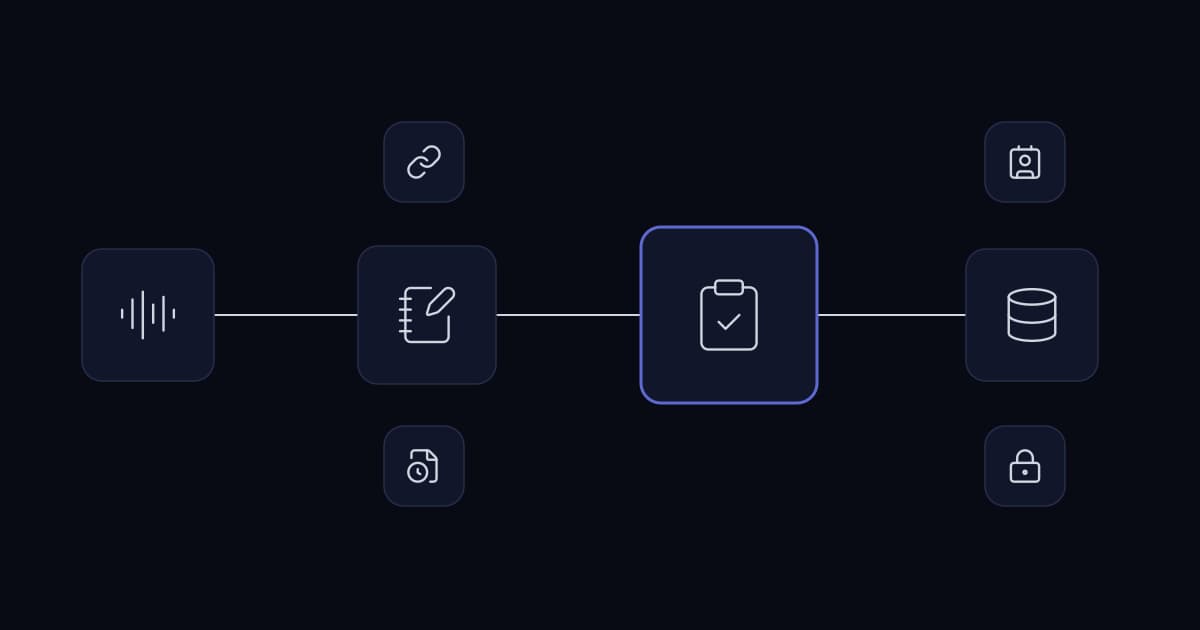
The call ends with an agent saying, “I will check whether we can offer that.” The generated summary says, “Discount approved.” The sentence is short, readable and wrong in the one place that matters.
AI call summaries should reduce after-call documentation without changing the meaning of a conversation. The workflow must preserve uncertainty, attribute statements correctly and separate a suggested follow-up from a commitment the business actually made.
Treat the summary as a draft interpretation tied to the source call. Validate consequential fields, let the responsible person correct them and record approved CRM changes independently from the generated text.
Define the record the team needs
A useful CRM note does not need to reproduce every sentence. It should explain why the customer called, what relevant facts were confirmed, what action occurred and what remains outstanding.
Decide which fields are descriptive and which can trigger business behaviour. A free-text summary is different from a follow-up date that creates a task or a disposition that changes reporting.
Do not let a generated narrative silently populate consequential fields. Give those fields explicit validation and review rules.
Keep uncertainty in the data model
A date can be confirmed, proposed or not established. A customer identity can be verified, partially checked or unverified. A requested concession can be approved, refused or pending.
If the schema only allows a single date or a yes/no value, the system may force ambiguity into an inaccurate field. Represent the states the conversation can actually contain.
Separate transcription from summarization
Transcription converts audio into text. Summarization interprets that text for a business purpose. An error in the first stage can become a confident claim in the second.
Evaluate both stages. Names, amounts, product codes and negations deserve particular attention because a small transcription error can change the record substantially.
Use the source recording for approved review where available and permitted. If audio is unavailable, make the limitation clear rather than implying that every detail can be verified.
Implementation reference
- OpenAI file transcription documentation— Consult the current transcription interface and supported options when selecting an audio-to-text implementation. Business-record validation remains an application responsibility.
Preserve speaker attribution
A customer's requested outcome is not the same as the agent's approved action. A statement about another department is not evidence that the department accepted responsibility.
Ask the summary to distinguish who said what where that distinction changes the business meaning. Keep the output concise, but do not remove the speaker context from commitments and disputed facts.
If overlapping speech makes attribution uncertain, route the relevant field for review. Guessing which person made a promise can create a misleading customer history.
| Conversation element | CRM representation | Review priority |
|---|---|---|
| Customer request | Requested outcome | Confirm it reflects the caller's goal |
| Confirmed action | Completed action with system evidence | High when it affects money or access |
| Proposed follow-up | Pending task or proposal | Verify owner and timing |
| Unresolved fact | Explicit unknown or disputed item | Do not fill from assumption |
| Agent commitment | Attributed statement requiring confirmation | Check wording and authority |
Use evidence anchors for important claims
Where the transcription system supports reliable timestamps or segment references, retain them for review. Link a consequential claim to the relevant portion of the conversation.
An evidence anchor does not itself prove the claim. It makes verification quicker. Reviewers should be able to inspect the source context around the statement, including a later correction.
If a customer first gives one address and then corrects it, the summary must not preserve the earlier value merely because it appeared first. Test corrections and retractions explicitly.
Do not ask for hidden reasoning
The reviewer needs observable support: the relevant utterance, source record and system result. A long generated explanation of how the model reached its answer is not a substitute.
Keep the review interface focused on the fields that matter. Too much commentary can make a simple correction harder.
Match the call to the right CRM record
Phone-number matching can help find candidates, but shared numbers, formatting differences and changed contact details can create ambiguity.
Use the established customer-identification process and stable application references where available. When several records match, do not let the model choose one based on a plausible name alone.
Keep the call correlation identifier separate from the customer identifier. It should be possible to correct an association without losing the original call record or creating a duplicate note.
Reference
- FreePBX CRM integration— The underlying matching and telephony-event problems remain separate from summary generation.
Validate commitments against system evidence
If the summary says a refund was issued, check the relevant transaction record. If it says a callback was booked, confirm the task exists with the stated owner and time.
A spoken intention and a completed application operation are different sources. Preserve both when necessary: the agent promised to investigate, and no refund has yet been issued.
Use deterministic validation where the system can establish a fact. Reserve human review for ambiguity and decisions requiring judgement.
Build review into after-call work
Present the draft where the agent already completes the case. Show the important structured fields and allow quick corrections without forcing a separate application.
Record the approved version and who approved it. Keep the generated draft only according to the defined retention policy; it need not remain forever simply because it existed.
Measure substantive corrections separately from stylistic edits. Replacing “customer” with a name is different from correcting the outcome, amount or responsible team.
Avoid turning review into a formality
If agents receive more drafts than they can inspect, the process can become automatic acceptance. Keep the review scope manageable and prioritize consequential fields.
Use sampled quality review to check whether approved notes still contain unsupported claims. A high acceptance rate is not evidence of accuracy if nobody has time to read the output.
Prevent duplicate CRM writes
A call completion event may be delivered more than once, and a worker may restart after the note was saved. Use a stable operation identifier tied to the intended note creation.
Store the confirmed CRM record identifier. If a response is lost, reconcile before creating another note.
A revised summary should update or append according to a defined history policy. It should not silently overwrite an agent's later correction. Compare source versions and preserve the difference between automated and human changes.
Minimize what leaves the call platform
Only send the material needed for the intended summary. A full call archive is not necessary for a single after-call note.
Consider sensitive segments, customer identifiers and information about third parties. Apply the organization's data-processing requirements and review the provider route before sending live calls.
Treat the generated note as sensitive where its content warrants it. Removing the audio does not remove the information from the summary.
Reference
- Enterprise AI data retention— Map audio, transcripts, drafts and diagnostic copies separately.
Evaluate the cases that create disputes
Include corrected amounts, negated statements, overlapping speech, uncertain dates and multiple products in one call. Test calls that end without a resolution.
Ask reviewers to judge the business record, not just whether the summary sounds natural. Required facts should be preserved, unsupported commitments should be absent and unresolved issues should remain unresolved.
Measure time to accept the note and the rate of important corrections. Compare with the existing after-call process using equivalent work and quality criteria.
Include multilingual conversations where relevant
A contact centre may switch languages within a call or use product names that resemble ordinary words. Evaluate those conditions if they occur in the real workload.
Do not assume that good performance on one language or recording quality transfers to another. Keep the supported scope explicit in the rollout.
A hypothetical renewal call
A customer asks whether a renewal can retain an earlier price. The agent says the request requires approval and promises to return with an answer.
The draft note records the requested price, the pending approval and the follow-up owner. It does not change the CRM renewal value or mark the customer as having accepted a new contract.
The agent corrects the proposed follow-up time before approving the note. The application creates a task with a confirmed identifier, and the approved summary links to it.
Later, a manager approves a different offer. That decision becomes a new record rather than a retroactive rewrite of what happened on the call.
Choose the first release conservatively
Start with internal draft notes on completed calls. Keep sending messages, changing financial fields and closing cases outside the first release unless those operations have separate approved controls.
Use a limited team and a clear correction process. Review errors before broadening the scope to more call types or languages.
A good first release reduces documentation effort while making the record easier to verify. It should not require accepting weaker evidence just to achieve a shorter handling-time metric.
Follow a summary into a real record
Consider a service call where the customer describes a recurring fault, mentions an earlier repair and asks about a replacement. A useful summary separates the reported fault, the historical claim and the requested next step. It does not convert the customer's question into an approved replacement.
Map each part of the summary to its destination. A case note can preserve narrative context. A status field may trigger workflow rules. A promised callback may create a task. These destinations carry different consequences and should not receive the same level of automatic trust.
Keep source references for details that matter to a later decision. A reviewer investigating a disputed commitment should be able to find the relevant part of the permitted transcript or recording while it remains available under the retention policy. The application should not imply permanent evidence if the source is scheduled for deletion.
When the source is unclear, preserve that uncertainty. An inaudible date should not become a plausible date. An unidentified speaker should not become the account owner. A missing field is often easier to resolve than a confidently incorrect value that propagates through the CRM.
Handle corrections as part of the workflow
Employees need a practical way to correct generated notes before or after they enter the record. Record who made a material correction and prevent the original error from being reintroduced by a later synchronization.
If a summary has already triggered an action, correcting the note may be insufficient. The related task, notification or status change may also need review. Link generated fields to their downstream effects so the operator can identify what requires reconciliation.
Avoid silently overwriting an employee's edited summary when the transcript is reprocessed. Treat the edited record as a version with its own authority. A newer model output is a suggestion, not automatic permission to replace reviewed business information.
Evaluate usefulness alongside extraction accuracy
A technically accurate summary can still be difficult to use. Ask the receiving team whether it helps them understand the request and act on it. Long chronological retellings may obscure the unresolved issue, while excessively short notes may omit the qualification that changes the decision.
Test across the types of calls the business actually receives. Include short enquiries, multi-issue calls, transfers and calls with no agreed next step. Evaluate the languages and audio conditions in scope. Do not extrapolate performance from a narrow set of clean demonstration recordings.
Define separate acceptance criteria for narrative notes and structured fields. A harmless wording variation in a summary is different from the wrong account identifier or action date. The review process should reflect that difference.
For commissioning, inspect the complete path from call capture to CRM display. Verify record matching, access restrictions, duplicate handling and the behavior when the CRM rejects an update. A good summary that attaches to the wrong customer is still a serious integration defect.
For a project discussion, bring redacted examples of current notes, the destination fields and the actions those fields can trigger. Explain which details employees must verify and which sources may be retained. KYCONNECTS can help design the integration around those boundaries, giving the team useful preparation without turning uncertain speech into unreviewed business commitments.
Questions about after-call AI
Can an AI summary replace the source recording?
A summary is an interpretation, not a complete substitute for the source. Whether audio should be retained depends on the business purpose and applicable requirements, assessed separately from summarization.
Should summaries automatically update all CRM fields?
Consequential fields need explicit validation and appropriate review. A generated narrative should not silently become an approved financial, contractual or access change.
How should an incorrect approved summary be corrected?
Use the CRM's defined correction or versioning process, preserve attribution and prevent an automated retry from overwriting the human correction.
Reference
- AI integration services— Connect summarization to a controlled CRM workflow.
- Communications services— Align call records, routing and operational reporting.
- Voice AI human handoff— Preserve the same evidence discipline during live escalation.
Discuss your requirements
- Scope call-summary and CRM integration— Bring redacted notes, destination fields and the actions those fields can trigger.
Services This Relates To
Written by KYCONNECTS Engineering. Client names are withheld under confidentiality.