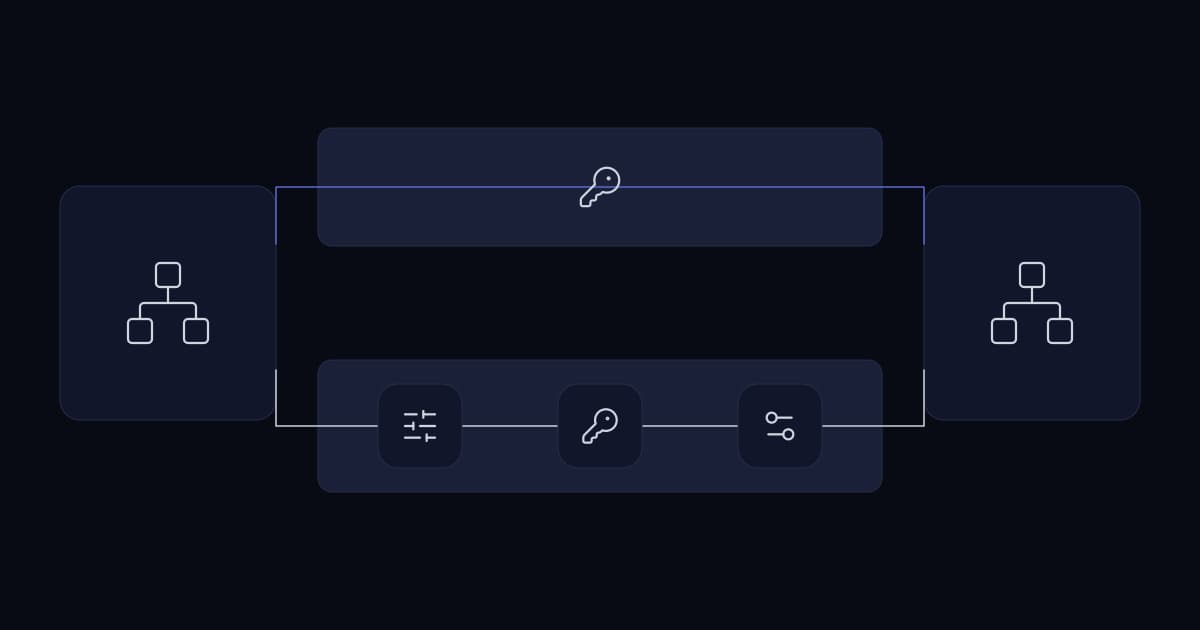
A business setting up remote access has to pick a protocol, and the choice is usually made by whichever the firewall documentation demonstrated first.
The two mainstream options are not variations on a theme. They make opposite decisions about the same design question — how much should be configurable — and everything that follows, including their respective weaknesses, comes from that one difference.
The design difference everything follows from
OpenVPN is built on TLS and inherits its approach: cipher suites are negotiated, transport can be UDP or TCP, authentication methods are pluggable, and a great deal is configurable at both ends.
WireGuard takes the opposite position. It fixes its cryptographic primitives — Curve25519, ChaCha20 and Poly1305 — with no negotiation, encapsulates IP packets over UDP only, and offers a deliberately small set of options.
The project is explicit about why. It aims to be comprehensively reviewable by individuals, in contrast to what it calls behemoths like IPsec implementations or OpenVPN with OpenSSL, where auditing the codebase is described as an overwhelming task even for large teams of security experts.
That is a genuine security argument and it is worth taking seriously. It is also a genuine constraint, because the same rigidity that makes it small makes it inflexible in specific situations.
| Property | OpenVPN | WireGuard |
|---|---|---|
| Cryptography | Negotiated cipher suites | Fixed primitives, no negotiation |
| Transport | UDP or TCP | UDP only |
| Codebase size | Large | Small enough to be individually reviewed |
| Where it runs | Userspace | In the Linux kernel |
| Configuration surface | Extensive | Deliberately minimal |
| Roaming | Reconnects | Full IP roaming on both ends |
| Crypto agility | A primitive can be swapped by configuration | Requires a protocol version change |
Where WireGuard wins clearly
Roaming
WireGuard supports full IP roaming at both ends: each side sends encrypted data to the most recent endpoint address from which it authentically decrypted data. A device moving between wifi and mobile data does not renegotiate anything — traffic simply continues from the new address.
For staff working from phones, trains and cafés this is the single most visible difference. It converts a category of user complaint — the VPN dropped when I moved — into something that does not occur.
Performance and simplicity
Running in the Linux kernel avoids copying packets between kernel and userspace, which is why WireGuard typically delivers higher throughput on the same hardware. On a firewall terminating many concurrent connections, that translates directly into capacity.
The small configuration surface is a security property as much as a convenience one. Most VPN weaknesses in practice come from misconfiguration rather than from a broken cipher, and a protocol with fewer options has fewer ways to be configured badly.
Where OpenVPN remains the right answer
Restrictive networks
WireGuard is UDP only. Hotel networks, some corporate guest wifi, and a number of countries block or heavily degrade UDP on arbitrary ports.
OpenVPN can run over TCP, including on port 443 where it is largely indistinguishable from ordinary web traffic to a simple filter. That is slower and less elegant, and it is the difference between working and not working in exactly the places staff most need remote access.
For a business with travelling staff, this single point frequently decides the choice — or produces the honest answer of running both.
Certificate-based identity at scale
OpenVPN's TLS foundation brings an established public key infrastructure model: per-user certificates, a certificate authority, and revocation through a revocation list. Where a business already runs a PKI, or needs individually revocable per-user credentials integrated with existing identity, that model fits.
WireGuard authenticates peers by public key, which is simple and effective, but the surrounding management — issuing, distributing, rotating and revoking keys across a workforce — is something you provide rather than something the protocol provides.
Crypto agility
Fixed primitives are a strength until one of them needs replacing. OpenVPN can move to a different cipher through configuration; WireGuard would require a protocol version change and a coordinated upgrade. This is a long-horizon consideration rather than a present concern, but for a system expected to run for a decade it is a real one.
Choosing
| Situation | Choice |
|---|---|
| Site-to-site between locations you control | WireGuard — simpler, faster, no roaming or filtering concerns |
| Mobile staff moving between networks | WireGuard, for roaming alone |
| Staff travelling through restrictive networks | OpenVPN over TCP 443, or both |
| Existing PKI with per-user certificates | OpenVPN, to reuse what exists |
| High concurrent VPN throughput on modest hardware | WireGuard |
| A supplier or client mandates a specific protocol | Whatever they mandate |
| Uncertain, mixed workforce | Both — the operational cost is lower than it appears |
That last row is worth taking seriously rather than treating as a non-answer. Running both on the same firewall is genuinely common: WireGuard as the default because it works better for most people most of the time, with OpenVPN over TCP as the fallback for the networks where UDP does not survive.
It costs a second configuration and a second set of credentials to manage. It removes an entire category of support call, and both terminate on the same platform without additional licensing.
What the choice does not change
Being clear about this prevents the protocol decision from absorbing attention that belongs elsewhere. Neither protocol changes any of the following, and all of them cause more real problems than the protocol choice does.
- Address collisions with staff home networks, which produce failures that look like protocol faults and are not.
- Whether internal DNS resolves correctly once connected.
- Whether access is authenticated with a second factor, which matters far more than the tunnel's cipher.
- What a connected device is permitted to reach, which is a segmentation and policy question.
- Certificate or key lifecycle, and whether anything monitors expiry.
A VPN using either protocol, terminating into a flat network, with single-factor authentication and no expiry monitoring, is a weak deployment regardless of which was chosen.
Is WireGuard more secure than OpenVPN?
It makes a different security argument rather than being straightforwardly stronger. WireGuard fixes its cryptographic primitives — Curve25519, ChaCha20 and Poly1305 — with no negotiation, and aims for a codebase small enough to be comprehensively reviewed by an individual, in contrast to what the project describes as behemoths where auditing is overwhelming even for large teams. That reduces both implementation risk and misconfiguration risk. OpenVPN's negotiated approach is more flexible and, correspondingly, offers more ways to be configured badly.
Why does WireGuard handle mobile devices better?
It supports full IP roaming at both ends: each side sends encrypted data to the most recent endpoint address from which it authentically decrypted data. A device moving between wifi and mobile data continues sending from its new address without renegotiating anything. For staff working from phones and while travelling, this converts a common category of complaint — the VPN dropped when I moved — into something that does not happen.
Can WireGuard run over TCP?
No. WireGuard encapsulates IP packets over UDP only. That matters because hotel networks, some corporate guest wifi and a number of countries block or degrade UDP on arbitrary ports, and those are exactly the places travelling staff need remote access. OpenVPN can run over TCP, including on port 443 where it resembles ordinary web traffic to a simple filter, which is frequently what decides the choice for businesses with mobile staff.
Should a business run both protocols?
Frequently, yes, and it is more common than it sounds. WireGuard as the default because it performs better and roams cleanly for most staff most of the time, with OpenVPN over TCP as the fallback for restrictive networks where UDP does not survive. The cost is a second configuration and credential set; the benefit is removing an entire category of support call, and platforms such as pfSense terminate both without additional licensing.
Does the protocol choice matter more than the rest of the VPN design?
No, and treating it as the main decision is a common error. Address collisions with staff home networks, internal DNS resolution, whether a second authentication factor is enforced, what a connected device is permitted to reach, and whether anything monitors certificate or key expiry all cause more real problems than the protocol does. A VPN on either protocol terminating into a flat network with single-factor authentication is a weak deployment regardless of which was chosen.
Sources and further reading
- VPN deployment: a practical guide— addressing, certificates, DNS and rollout — the concerns this article deliberately excludes
- Secure remote access architecture— what a connected device should be permitted to reach
- pfSense in a business network— the platform that terminates both without extra licensing
- MFA strategy for business— the second factor that matters more than the cipher
- Network segmentation for growing businesses— why terminating a VPN into a flat network undoes the tunnel
- Zero trust architecture for growing businesses— the direction that reduces reliance on the tunnel as a trust boundary
- WireGuard— the fixed primitives, UDP encapsulation, kernel implementation and roaming behaviour cited above
- WireGuard protocol and cryptography— the handshake and primitive selection in detail
- OpenVPN community documentation— configuration, transport options and PKI reference
Services This Relates To
Written by KYCONNECTS Engineering.